

 Loading...
Assistant Economist Scheme Page
| Assistant Economist Graduate Scheme |

NOTIFY ME WHEN APPLICATIONS OPEN
The Government Economic Service Assistant Economist Graduate Scheme is now closed for applications.
The Government Economic Service (GES) is at the heart of decision-making in the UK Government. Our 3,500+ economists work across more than 70 departments and agencies, from HM Treasury to the UK Space Agency! We are the largest employer of economists in the country.
The Assistant Economist Graduate Scheme is a nationwide recruitment scheme for economics graduates. To help us deliver high quality, high impact analysis we are looking for economists to join us and influence the day-to-day lives of every person in the UK.
Learn more about the Government Economic Service, our recruitment schemes, and the benefits of working as a government economist here.
About the Scheme
As an assistant economist, you will be joining community of economists across government, putting your economic learning to direct use by influencing high profile public policies with the best possible economic analysis.
This is an exciting time to be joining the Civil Service, and with continuous support you’ll produce analysis, prepare vital briefings for senior officials, ministers or the public, provide advice on policy options, and ensure the quality and appropriate use of economic statistics.
How much will I earn?
Salaries vary according to government department and location. Salaries available for the 2026 scheme are: London minimum: £36,824 / national minimum: £34,123. Please see the 2026 scheme departmental job descriptions for details.
Where will I work?
Locations vary according to government department. Locations available in the 2026 scheme are: Birmingham, Bristol, Cardiff, Darlington, Edinburgh, Glasgow, Leeds, Liverpool, London, Manchester, Newcastle, Newport, Salford, Sheffield, Titchfield (Fareham), Wolverhampton, York. Please see the 2026 scheme departmental job descriptions for details.
Please note that while we do have some opportunities in London, the majority of the roles available in our 2026 scheme are based outside London in regional locations across the UK.
What departments are recruiting?
Please see the 2026 scheme departmental job descriptions during the application window for details.
Developing your skills
We take your development seriously and there will be plenty of support to further your development as an economist. You will broaden your subject knowledge through 50 hours of continuous professional development a year and a further 50 hours on developing your personal skills.
The GES offers an excellent range of learning opportunities to help you develop:
- strong quantitative skills: you’ll become an expert in analysing and presenting data
- writing and presentation techniques: communicating economics clearly and succinctly to senior officials and ministers
- applied economics skills: using economic insights and techniques to inform policy on anything from the environment to transport.
Eligibility
Applicants must have, or be on track to receive, a first - or upper-second-class honours degree (or international equivalent) in economics, or a postgraduate degree in economics.
By August of the year you apply, you must hold at least one of the following:
An undergraduate degree in economics
A joint economics degree, where at least 50% of the credit value of all modules studied is in economics
a postgraduate degree in economics
All candidates must have studied both micro and macroeconomics to qualify.
If you graduated more than five years ago then you must give examples of how you have maintained your economic knowledge in the pop up box on the application form.
Nationality requirements
Please note that it is possible to meet the nationality requirements and still not be legally entitled to work in the UK.
Individuals will need to demonstrate their eligibility under the Civil Service Nationality Rules (CSNRs).
Candidates must have the right to work in the UK, as we do not offer sponsorship.
For full details please see Nationality requirements.
Application process
This vacancy is using Success Profiles (opens in a new window), and will assess your Ability, Behaviours, Experience and Strengths.
The recruitment process involves the following steps:
- Online application form
- Civil Service Verbal and Numerical Tests
- Application sift (marking)
- Online interview (Economic Assessment Centre)
- Offer
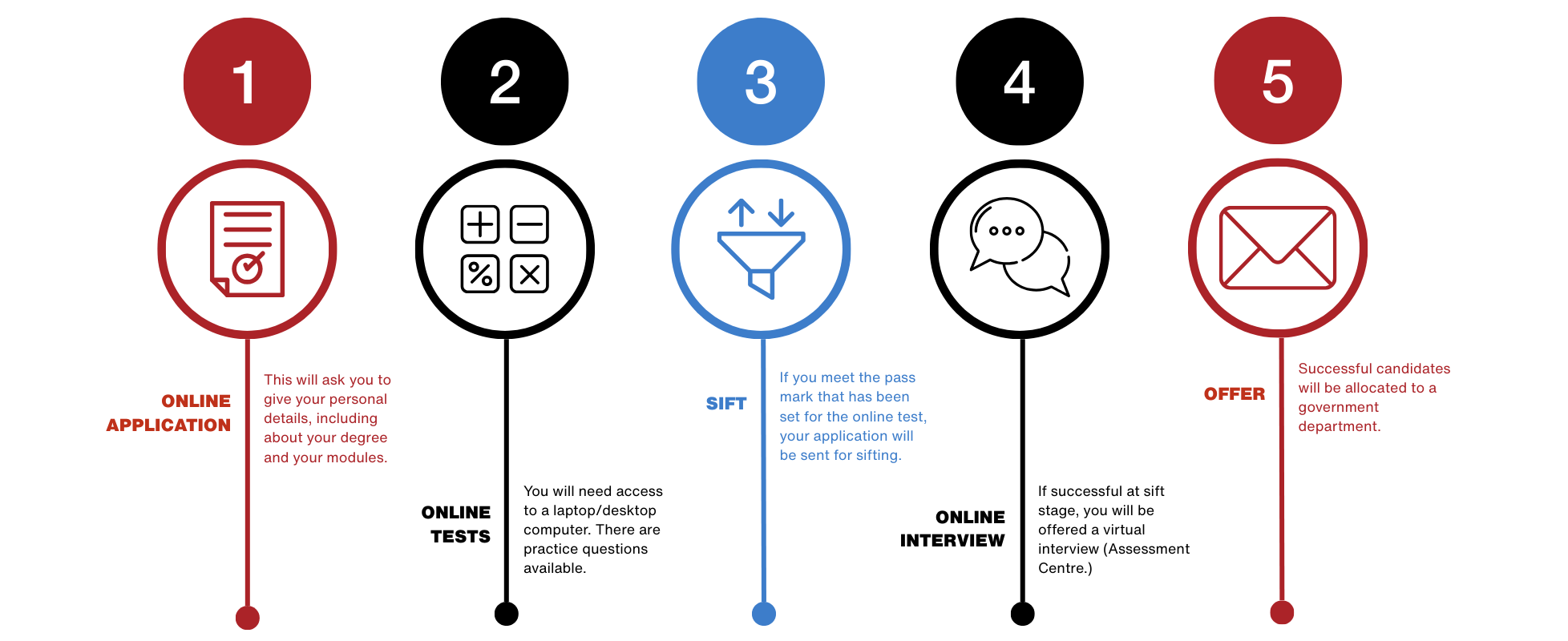
Here is some information on each of the 5 stages:
Stage 1: Online application
To begin your application, you will need to register on this site using the ‘apply now’ button above (available during the application window). You will be asked to give your personal details, along with details of your academic qualifications. You will be asked to detail all modules from your degree and their credit value, clearly indicating which are economics modules. You must ensure that you mark your microeconomics and macroeconomics modules clearly
Use of Artificial Intelligence (AI)
Artificial Intelligence can be a useful tool to support your application, however, all examples and statements provided must be truthful, factually accurate and taken directly from your own experience. Where plagiarism has been identified (presenting the ideas and experiences of others, or generated by artificial intelligence, as your own) applications may be withdrawn and internal candidates may be subject to disciplinary action. Please see our candidate guidance for more information on appropriate and inappropriate use.
Stage 2: Civil Service online tests (verbal & numerical)
After you have completed the application form, you will be required to complete two online tests: verbal and numerical. The link to the tests will be sent to you by email. You can complete these at a time that suits you, the tests do not need to be taken together, but both tests must be completed before the application deadline. You will need to complete the verbal test first and then the numerical test. You will need access to a laptop/ desktop computer.
The tests are not timed. Once you have started a test, you will need to complete it in one sitting. You cannot exit and return to it. Please ensure you use the same email address for the tests that you used for your online application.
There are practice tests available to help you prepare and to know what to expect. Please do use them. Access the practice verbal test and detailed test guidance. There are also video guides to the Civil Service tests available.
Please note: The test deadlines are the same as the application deadline. Make sure you leave yourself plenty of time to complete the tests - don’t leave it to the last minute. You don’t want to miss the deadline if you encounter last minute technical difficulties!
After applications have closed, pass marks for the online tests will be set. You will then receive an email advising whether you have passed the tests.
Stage 3: Sift (marking)
If you meet the pass mark that has been set for the online tests, your application will be sent for sifting (marking) where assessors will look at the economics components of your degree. If you are successful at the sift, you will then be invited to an Economic Assessment Centre (EAC), which is an online interview with some additional tasks and activities.
Unfortunately, due to application volumes, candidates who are unsuccessful at the sift stage will not be given any feedback or comments.
Stage 4: Online interview (Economic Assessment Centre)
If you pass the sift, you will be invited to a virtual Economics Assessment Centre (EAC). For the first part of the EAC you will be asked to complete a timed written exercise which will be marked by two civil servants. This will be followed by an interview stage where your knowledge of economics will be tested along with Civil Service behaviours and strengths.
The Civil Service Behaviours that you will be assessed against, at interview stage, are:
Making Effective Decisions
Delivering at Pace
Working Together
The Economic Assessment Centre (EAC) is designed to assess a candidate’s economics skills against set criteria. If you are invited to the Assessment Centre, further information on what to expect will be shared with you ahead of time.
Feedback will only be provided if you attend the Economics Assessment Centre. Due to a large volume of applications, we are unable to provide feedback on applications prior to this stage.
Candidates choose a strongest topic to address at the Economic Assessment Centre. The list from which they can select this is specific each year.
Full information on what to expect at the Assessment Centre will be sent to candidates invited to attend.
Successful candidates will be offered an assistant economist role subject to meeting entry requirements, references, and security checks.
Stage 5: Offer
If you are successful and are offered an assistant economist role, you will be allocated to a government department. Allocations will be made in merit order based on interview scores. We will try to place you into one of your top three location preferences, however due to large numbers of applications this is not always possible.
Occasionally, a department might withdraw from the scheme before placements are offered or there could be more successful candidates than available placements. In such cases, applicants are placed on a reserve list. The reserve list is open for 6 months.
Pre-appointment checks
If you are offered a role, you will be sent an email with the contact details of the government department you have been placed with. Your department will then be in touch directly to begin pre-appointment checks, including security clearance. You cannot start your placement until your security checks are completed.
Some departments – but not all – require candidates to have lived in the UK for 3 to 5 years and to have spent a period no longer than 3 months or more at any given time outside of the UK to obtain security clearance.
You should address any questions regarding your role and contract to the department you have been allocated to in the first instance.
Candidate Q&A session
Here is a recording of the main presentations from the online candidate Q&A session that took place on 10 February 2026.
Recruitment timetable
The expected timetable for the 2026 scheme is outlined below. Please note that dates for sifting, interviews and offers are subject to change.
Online applications open | 03 February 2026 – 27 February 2026 (16:00)
Online tests | Complete before 27 February 2026 (16:00)
Sift | April 2026
Economic Assessment Centre:
Timed written assessment | w/c 27 April 2026
Interview stage | From w/c 18 May 2026
Offer | July 2026
Frequently asked questions
Question: Can I request extra time for the online verbal and numerical tests?
Answer: As the tests are not timed, there is no need to request extra time. Further information on reasonable adjustments is incuded in the email inviting you to take the tests.
Question: I have recently taken the Civil Service Verbal and Numerical Tests – do I need to take them again?
Answer: Yes as the GES Assistant Economist Graduate scheme uses a different numerical and verbal reasoning test.
Question: I did a degree with many modules. What should I do if I cannot display all my modules studied in the table provided?
Answer: If you cannot add all modules to the table, please use the box below the module table to complete the full list of your modules studied and their credit values. The box is titled “Please include any other relevant information highlighting the economics focus of your degree".
Question: Where do I show that I have studied macro and microeconomics, which is a core requirement?
Answer: You should tick the boxes which ask ‘does your course include a macroeconomics module’ and ‘does your course include a microeconomics module’. You should also list and clearly label all macro and microeconomics modules and their credit values in the module table provided.
Question: I have previously applied for the GES Fast Stream. Can I still apply for the GES AE Scheme
Answer: Yes – this scheme is open for all graduates with a first or 2:1 in economics, or in a joint economics degree where at least 50% of the credit value of all modules studied is in economics, or with a postgraduate degree in economics (please see the eligibility page for more details). If you have applied to previous GES Fast Stream or other schemes prior to this one, you are not disqualified from applying to this scheme.
Question: Is security clearance required?
Answer: Yes. If successful you must hold, or be willing to obtain, security clearance to CTC/SC/DV level. Certain departments require a 3-5 year footprint in the UK. More information about the vetting process can be found here. More information can be found in the departmental job descriptions.
Question: What is the difference between the Assistant Economist Scheme and the Fast Stream?
Answer: The GES Assistant Economist Graduate Scheme is the recruitment pathway for economist careers within the Civil Service. It, therefore, focuses on developing the technical skills and experience needed to be a government economist and the wider behaviours that will support you to be an effective Civil Servant. By comparison, the GES Fast Stream scheme is an accelerated development programme that seeks to develop future leaders, both in the GES and the Civil Service more widely and therefore has a specific focus on developing leadership skills and experience.
Both schemes test and will develop your economics knowledge, and your ability to apply and communicate that knowledge to both technical and non-technical audiences. Training to support the development of technical and leadership skills will be available in either case.
Question: Can I choose which department I will work for?
Answer: No, but we do ask for your location preferences. If you are successful at all stages for the campaign, when assigning you to a department, we will consider your preferences, but we cannot guarantee that you will get your choice of location.
Question: If I am successful, will I be offered a role in one of my preferred locations?
Answer: When making your application we ask that you select at least one, and up to three, preferred locations from the list of those available for this year's scheme. If we are unable to offer you a position in your first choice location we will look to assign you to either your second or third choice locations. Please only select locations that you can genuinely consider being based in. While we will try our best to offer you a position in one of your preferred locations, this is not guaranteed. We may need to offer you a different location to meet departmental needs.
Question: I am a current civil servant – can I apply?
Answer: Of course, as long as you meet the entry requirements!
Question: How do I set out my application if I have done a joint degree?
Answer: The application form gives full information, and it is your responsibility to set things out clearly. The key things are to list all your modules for every year of your degree, note which are macro and microeconomics and put in the credit values of every module, whether these modules are in economics or not.
Question: Can I apply if I have done PPE?
Answer: Yes, as long as 50% of the credit value of the modules studied over the full course of your degree are in economics. It is your responsibility to provide full information as above.
Question: Why do I need to list credit values for my courses?
Answer: This is to enable us to make a correct assessment on eligibility which is based solely on the information you provide in your application form.
Question: My degree lasts more than three years - do I need to list all modules for every year of study?
Answer: Yes, and include the credit values of each module.
Question: If I have studied a placement year/ year in industry/ study abroad year, do I need to list the modules and credit values from this year?
Answer: Yes, but make it clear that you took a year out. Further guidance is provided in the application form.
Further information
Contact point for applicants
GESR Recruitment Team: gesrrecruitment@hmtreasury.gov.uk
Please note that the GESR Recruitment Team work Monday-Friday 9am – 5pm. Therefore, technical support will not be available outside of these hours, including those leading up to the 16:00 application deadline on 27 February 2026.
Working for the Civil Service
The Civil Service Code sets out the standards of behaviour expected of civil servants.
We recruit by merit on the basis of fair and open competition, as outlined in the Civil Service Commission's recruitment principles.
The Civil Service embraces diversity and promotes equal opportunities. As such, we run a Disability Confident Scheme (DCS) for candidates with disabilities who meet the minimum selection criteria.
Diversity and Inclusion
The Civil Service is committed to attract, retain and invest in talent wherever it is found. To learn more please see the Civil Service People Plan and the Civil Service Diversity and Inclusion Strategy.
Complaints procedure
Our recruitment process is underpinned by the principle of appointment based on fair and open competition and appointment on merit, as outlined in the Civil Service Commissioners’ Recruitment Principles. If you feel your application has not been treated in accordance with these principles and you wish to make a complaint, you should in the first instance contact HMT by email at: gesrrecruitment@hmtreasury.gov.uk.
If you are not satisfied with the response you receive, you can contact the Civil Service Commission, which regulates all Civil Service recruitment. For further information on the Recruitment Principles, and bringing a complaint to the Civil Service Commission, please visit their website at: https://civilservicecommission.independent.gov.uk
Contract Terms and Applications
Contracts are open to accommodate working pattern needs and can be on a full or part-time basis as set by the relevant departments. All civil servants are appointed on merit through fair and open competition. The selection process will consider your attitude, capability, talent and willingness to learn. If appointed you will be expected to carry out your role with dedication and a commitment to the Civil Service and its core values of integrity, honesty, objectivity, and impartiality.
If you have any questions about this scheme or our recruitment processes, please contact the GESR Recruitment Team on gesrrecruitment@hmtreasury.gov.uk or follow us on social media.
|


NOTIFY ME WHEN APPLICATIONS OPEN
Privacy Statement Terms and Conditions Accessibility Statement Cookies Statement |
 Copyright 2025 GES-Careers